
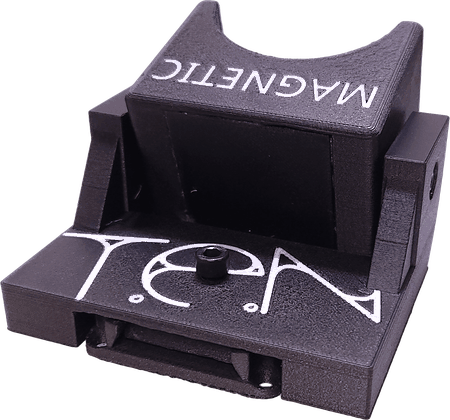
Magnetic guitar stand · patent pending
The Rodfather
It holds your guitar by the one part of it that was always magnetic — the truss rod. No straps, no retaining arms, no modifications. Just grab it and play.
The problem with guitar stands
Traditional guitar stand geometry is an accident waiting to happen. We've all witnessed it — a slight bump, an uneven surface, someone's foot catching on a stray cable, followed by a moment of slow-motion terror.
The Rodfather turns the guitar's weight distribution into an advantage. It lowers the centre of gravity and secures the upper section to the most stable item on the stage: your amplifier.
How it works
Nearly every guitar built since 1921 has a steel truss rod running the length of the neck. It's already in there, and it's already ferromagnetic, but for reasons that elude me, no one had ever thought to use it to actually retain the guitar against a stand.
Right behind the velvet-flocked cradle sits a rare-earth magnet - just rest the back of the neck in the scoop, and the magnet reaches straight through the wood and grips the rod inside. Your guitar is held firmly enough to survive the kind of knock that topples most stands, and gently enough to lift away with one hand.
It takes roughly two pounds of force to pull the neck out of the cradle — enough that a bump won't do it, little enough that you barely notice it's being restrained.
The parts
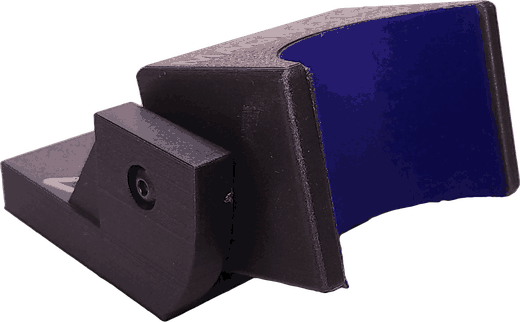
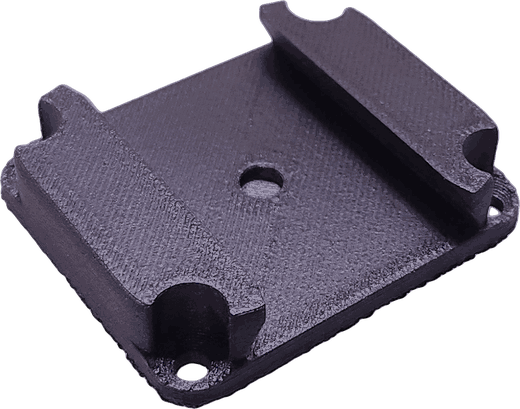
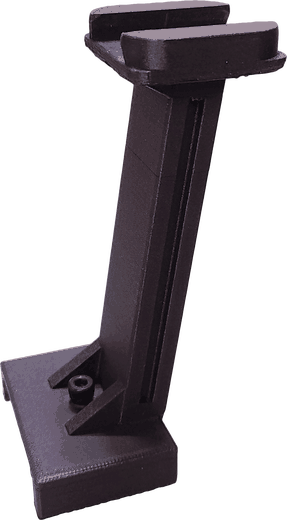
- Neck cradleThe velvet-flocked scoop your neck rests in, with the magnet installed from the back and sealed in place.
- Pivot screwsHand-adjustable, so you can set the cradle angle. No tools required.
- CarrierThe body of the unit, with a trapezoidal key that slides straight onto the base plate.
- Plate-lock screwSecures the carrier to the base plate. Finger-tight is more than enough.
- Base plateMounts to any solid surface, and stays put when the rest of the unit slides off.
- Extension moduleIncreases the stand-off from the mounting surface, vertically or horizontally. Sold separately.
In the box: the stand, four mounting screws, a 2mm drill bit, and an adhesive pad pre-cut to the base plate.
Mounting it
Lean your guitar against the amplifier and note where the back of the neck meets the cabinet. That's where the plate goes. It can be mounted horizontally or vertically, rotated in any direction, and it accepts the carrier from either side. The cradle's range of motion spans a full 90 degrees.
Fix the plate with the supplied screws, using it as a drilling guide with the 2mm bit — taking care to avoid anything living inside the cabinet. Or use the adhesive pad, which is 3M 9474LE cut to fit. Clean both surfaces with isopropyl alcohol and let them dry properly, because that part matters. Press down firmly for thirty seconds.
Then slide the carrier on, turn the thumbscrew until the tip drops into the recess in the plate, and tilt the cradle by hand until it faces the back of the neck squarely. Rest the lower bout on the floor, lean the neck in with the strings facing out, and you'll feel the magnet take it. To remove the guitar, pull the neck sideways out of the cradle.
Will it work with my guitar?
If it has a steel truss rod, it works. That covers nearly everything — solidbody and semi-hollow electrics, steel-string acoustics, basses, and bolt-neck, set-neck and neck-through construction alike.
It won't work with classical and flamenco guitars, vintage instruments built without a truss rod, or necks using a graphite or other non-ferrous reinforcement rod instead of steel.
Necks vary in shape, thickness and density. A chunky vintage-profile neck puts more wood between the magnet and the rod than a thin modern one, so it holds a little more lightly. Both are well within the range this was designed for, but if you play a very deep-profile neck, expect a slightly softer grip.
Safety
The Rodfather contains a rare-earth magnet of considerable strength. It's fully enclosed and bonded in place, and in normal use it's safe for most situations — but a magnet this strong deserves a few words.
| Medical devices | Strong magnets can interfere with pacemakers, implantable defibrillators, insulin pumps and other implanted or worn medical devices, and interference can occur without contact. Keep the unit well clear — a minimum of 12 inches — and consult the device manufacturer's guidance before use. |
|---|---|
| Pinch hazards | It snaps hard to steel and iron without warning. Fingers caught in between can be pinched or bruised. Keep a firm grip near ferrous metal and know where your fingers are. |
| Cards, media, watches | Keep it away from credit and hotel key cards, magnetic-stripe media, hard drives and mechanical watches. It can erase or damage them at short range. |
| Pickups | Don't press the cradle against your pickups. They contain their own magnets, and prolonged close contact with one this strong can weaken them. In normal use the cradle only touches the back of the neck. |
| Adhesive mounting | The supplied adhesive is industrial strength and is not designed to come off cleanly. On tolex, vinyl, painted or veneered surfaces, removal may lift the covering or damage the finish. |
| Heat | Don't leave it in a hot vehicle or in direct sun for long. Rare-earth magnets lose strength permanently at high temperatures and the polymer will soften. A parked car in summer can exceed both limits. |
| Disassembly | The magnet is bonded behind a sealed cover and is not user-serviceable. Taking it apart risks injury from the magnet snapping to nearby metal, and from cracking or chipping — rare-earth magnets are brittle and can fracture into sharp fragments. |
| Children and animals | This is not a toy. It contains small parts and a strong magnet, and swallowing either is a serious hazard. |
Be careful, be safe, then shut up and play yer guitar.
Specifications
| Magnet type | N52 rare-earth |
|---|---|
| Release force | ~10 N (roughly 2 lb) to lift the neck clear |
| Max neck width | 2.12" |
| Cradle range of motion | 90 degrees |
| Weight | 1 lb 4 oz |
| Dimensions | (h) 2.1" × (w) 3.5" × (d) 4.1" |
| Materials | Carbon-fibre reinforced polymer, steel threaded inserts |
| Status | Patent pending |
| Price | $120 |
| Extension module | $28, sold separately |
| Base plate 5-pack | $20, sold separately |